Showing posts with label wool picker. Show all posts

Friday, June 15, 2012

A New (to me) Drum Carder!

More to talk about than seemed right for a single post, so here goes post number two of the day.

In other news, I found another piece of equipment I've been lusting after and it's now in my studio.  I've been studying up on drum carders for several months, and after trying out a friend's machine recently, had made up my mind that I would really like to have one for all the fiber I have dreams of processing.  After studying up on all the different carders available, I had decided on either a Pat Green, Strauch Finest, or a Fancy Kitty carder. All seem like good quality, well-built machines.  And users of all three are very happy with their products.   I finally determined that a Fancy Kitty "Big Tom" motorized carder was the one for me.  The biggest selling feature is that the drums are interchangeable.  So I could start with the standard 120TPI carding cloth and eventually purchase other drums with finer or coarser cloth depending on my needs.  Still expensive because the carding cloth is the costliest part of the machine, but still better space-wise and pocket-book-wise than buying multiple machines. 

I also lurked in the Fancy Kitty forum on Ravelry and was impressed with the customer service.  It seems as though every time someone mentions that they have a problem, Ron is there immediately to answer questions and even asking them to call so he can walk them through the steps.   And there are frequent follow-up posts saying that Ron spent considerable time on the phone and helped them solve their problems. 


So I had made up my mind what I wanted and decided to set aside a chunk of my paycheck every month until I had saved up enough to order directly from Ron.  In another moment of serendipity, a lovely lady from Missouri named Erin posted on Ravelry that she wanted to sell her Big Tom with not one, but two drums (90 TPI and 120 TPI) at a hugely reasonable price.  At the same time I had a windfall - not enough to buy the new drum carder, but enough to buy Erin's gently used one.

Isn't This the Coolest Thing?
 We talked on the phone several times and agreed on the price and shipping details.  A couple of clicks on Paypal, and the drum carder was packed up and on a UPS truck before I even caught my breath.  I emailed Ron at Fancy Kitty to ask if there were instructions on the carder.  He charged a very small price for the copies and I had them in the mail in two days.  That's good customer service.

I had decided that since it was such a big ticket item, and since Erin would want the delivery signed for, I should have it shipped to my office.  First mistake.  Wednesday morning bright and early, I got my text message from UPS saying that my package had been delivered.  Huh?  Not to my office.   Some searching on the UPS site and a live chat later, I learned that the truck driver opted to deliver to Central Receiving rather than to the building and room specified on the label.  So Central Receiving accepted it.  And put it on their truck for delivery to me that afternoon.  And of course my department was their last stop.  Just before close of business.  So much for my plan to unpack, assemble, and make sure it worked properly before taking it home.

Rushed home and before going to my Wednesday night class, I had just enough time to assemble it and briefly try it out. I did have a few tense moments at first. The big drum motor worked right off the bat but the licker in didn’t. Fiddled with things and found one plug that wasn’t all the way in. So got both motors working and put both drums in according to instructions I got from the Kitty people. Turned it on and nothing happened! Somehow I had managed to turn both of the speed dials all the way down.  Phew!

I tried it out on the Dorset wool I’ve been preparing and it was a disaster! I think the carder was working fine but the fiber needed more prep (or may need to be a felting project).  This photo shows the batt that refused to come together.  Lumpy and slubby and yuck.


 I thought the Dorset was not a fair test of the drum carder and certainly not a fiber for learning to fine-tune the drum placement, so I decided to try out some of my alpaca.  Since I had already successfully made several batts on a friend's drum carder, I knew what to expect.

First I took a few minutes to pick the fiber because there were loads of intact locks.   Used my Kaydessa picker, and it quickly turned the clumps into fluffy clouds of softness.

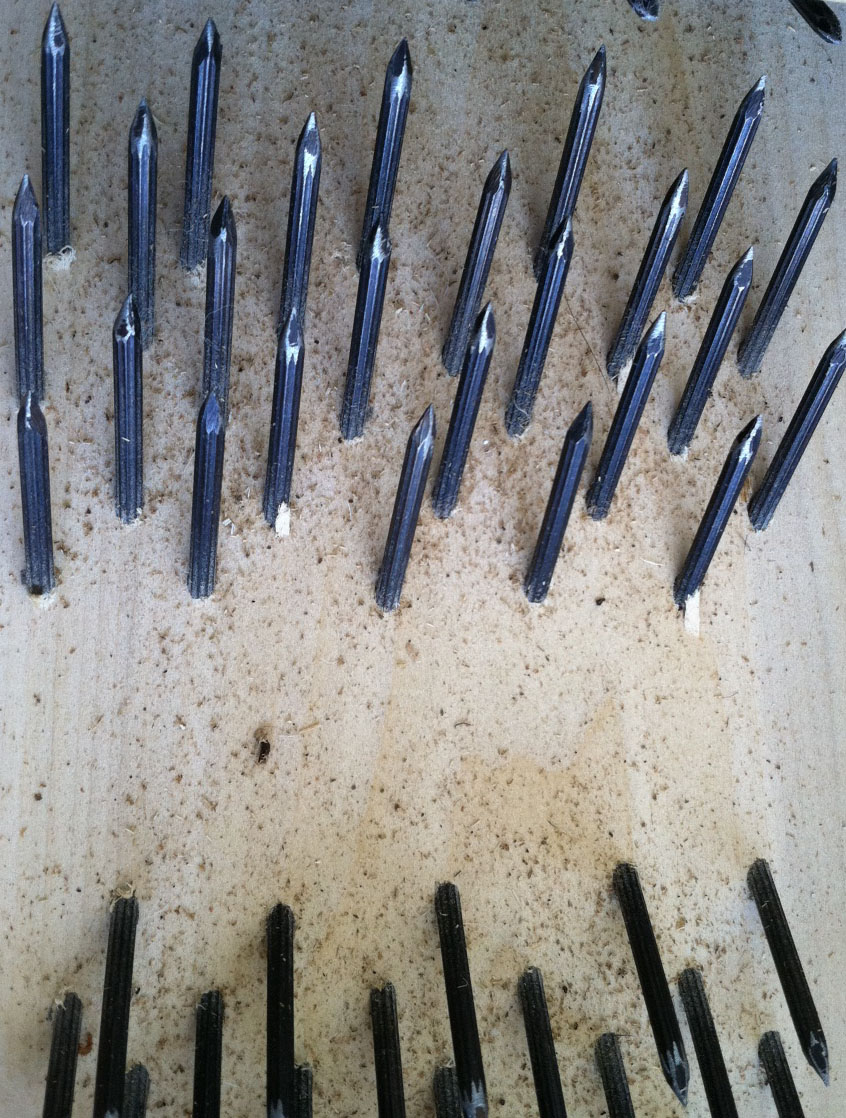
Don't think I've shown what it looks like.  It's an interesting and fairly innocuous looking box.


Then you open it up and it's a lethal weapon!


Here it is in action:


So I ran the picked alpaca through the carder, and still had problems getting smoothly from the licker-in to the big drum.  I certainly need to do some studying and adjusting before I get this right, but once I do, look out!  Major art batts coming soon.

Here's the first pass being taken off the drum.  Left behind quite a bit in the carding cloth and need to work on that skill as well.


And here's the finished batt - after two passes through the carder.  Not quite a smooth as the ones made on my friend's machine but pretty good for a first try.  But you can clearly see that there are tiny (and some not-so-tiny) bits of VM throughout the fiber, despite vigorous cleaning and picking.  Guess I really do need that fiber tumbler.  Hmm...  wonder what my beloved woodworking nephew is doing this weekend?


Monday, June 11, 2012

More sulking, fermented fleece, one finished object!

In our last episode, our intrepid heroine was recovering from a bad cold.   Not!

Cold turned into sinus infection and bronchitis.  Toughed it out at work for three days, succumbed and stayed home on Friday.  Started antibiotics and hoped that I would feel better by Saturday, but NO!  I had to miss my spinning guild's field trip to an alpaca farm and fiber processing mill.  Major disgruntlement.

Between naps, I finished the apricot colored scarf on the rigid heddle loom.  Not knowing for sure the fiber content, I cautiously wet-finished it Saturday night.  It looked like the fibers were blooming and I was going to lose the lacy effect of the loose weave I had done, but the bloom pretty much disappeared as the scarf dried.


I was slightly disappointed, though, with the finished product.  The fibers I had used were pretty soft and I thought the scarf would drape nicely.  After drying, the scarf was very, very stiff.  I'm not sure what caused this -- I rinsed it thoroughly, and the weave structure is fairly loose so...    Will revisit this some other time.  Also debating about the length of the fringe.

I finally tackled the Dorset fleece I had soaking in tubs in the back yard.   But so far it has not turned out well.

Two weekends ago, I put one of my purchased fleeces in two tubs of water, intending to give them an overnight soak.   The next day, the water in both tubs was absolutely filthy, so I drained and refilled the tubs, figuring that another soaking would help reduce the amount of yuck that ended up in my sink.   Then I figured another day or two of soaking wouldn't hurt a thing and planned on processing the fleece over the next weekend.  Then I came down with the plague and didn't care much one way or another about the fleece.

When I finally started feeling human again yesterday, I decided to see about finishing the cleaning process.  Here's what I saw when I opened the first tub.


And a close-up:


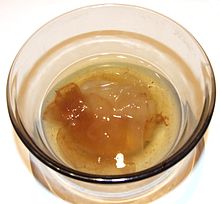
Looks like there is a layer of scum floating on top of the water here -- but it's actually a huge blob of slimy goo suspended in the water.  Have you ever had a bottle of vinegar that wasn't completely pasteurized develop a "mother?"  It reminded me very much of one of these:


Yuck.  I couldn't get it out of the water.  In hindsight, I should have been patient and used a strainer on it, but I'm not sure even that would have worked.  So when I gave up and lifted the fiber out of the water, the yuck seemed to follow the fiber and clung all over it. 

Other aspect of this was the odor.  Strike that word.  The STINK!  Now I have had a very poor sense of smell since childhood.  Added to that, with my clogged sinuses, I wasn't smelling very much of anything.  But the stink that emanated from this brew was incredible.  So much ammonia that it was like walking into a 1960's beauty parlor times 10.  I'm surprised the neighbors didn't call the authorities on me.  Picture a few dozen hazmat-clad, gun-wielding g-men descending on my back yard.

I've been reading up on different methods of cleaning fleece, and it sounds like I stumbled onto the "fermented suint" method.  Basically, you put a very greasy fleece in a tub of rain water (theoretically more free from mineral content than most other water sources) and let it sit for days until it ferments.  The chemical reactions between the water and the suint (sheep sweat) combine to loosen the lanolin (sheep oil) from the fleece, which becomes some kind of soapy concoction that you then use to soak future fleeces for a day or two.  Theoretically it is a "greener" process because it requires far less water to clean a fleece.

Perhaps if I had not used garden tap water, I might have accidentally had a better result.  But here in my part of  SoCal, we very seldom have enough rain water to do more than water the lawn a bit, so I've never looked into collecting rain water.  And now that I know how bad a fermenting fleece smells, I don't think this cleaning method will motivate me.

So I set the fleece on a big screen to dry in the sun.  Not pretty.  The yuck from the water dried to a rusty pink film that I could not separate from the fleece.  And the smell is pretty bad.  So bad, the hundreds of birds that live in my back yard haven't gone anywhere near it.  Come to think of it, I haven't even seen a bird since I opened up the tubs.


Figured that this fleece is probably a total loss, so might as well experiment on it.   I put some into a couple of lingerie bags, and soaked in hot water -- one with Unicorn Power Scour and one with Dawn.  Neither one dissolved the pink yuck, but I think the Unicorn may have pulled a bit more dirt out of the fleece. 

Let the two bags dry overnight.  The good news is that once dry, the smell seemed to disappear.


You can see that the fleece is now a lot whiter, but it's covered by these little pinkish specks.  Still not pretty.  So I put some of it through my Kaydessa Lil' Dynamo wool picker.  It took several passes and a time out to let some fibers that were still a bit damp dry thoroughly, but the pink stuff is flaking off.  In fact, here's what the bottom of the picker looks like after putting just an ounce of fiber through two times.


The inside of the picker was immaculate before I started picking.  All those specks that look like sawdust are actually flakes of the yuck that came off the wool. 

And after two passes through the picker, the wool looks like this:


Still some pink stuff in there but much cleaner and whiter.   I tried washing some of the picked fiber again yesterday to see if it would come any cleaner.  Just waiting for it to dry thoroughly before making any decisions about proceeding.  

They say that Dorset fleece can take some abuse without felting.  Guess I'm going to find out just how much it can take.  I doesn't seem to be that difficult to pick.  We'll see how it cards and then spins.  If it's ok, I may just experiment with some dyes to cover up whatever stains are left behind.  Or maybe the whole lot will just go to the giant compost heap in the sky. 


Wednesday, April 11, 2012

Fun With Alpaca


Had to stay home today to take my little pal, Tallulah, to the vet.  Poor baby stayed up scratching and crying all night.  Turns out she probably had a flea, spider, or ant bite and had an allergic reaction.  A shot relieved her itching quickly and now she's dozing while I do some studying.

 By the way, there are lots of people who spin dog fiber - some who even make a profession of spinning it for people who want keepsakes of their beloved pets.  I'm saving hair from Tallulah's groomings to try it out myself.  But that's a topic for another time.  For today it's just a good excuse for putting her picture in my blog.


As long as I'm home, thought I'd take advantage of the quiet to process some of my alpaca stash.  Since washing it requires a lot of soaking time, this is a perfect multi-tasking opportunity for me.

This is my first experience with alpaca, so I've been doing quite a bit of reading about how to prepare it.  People seem to be divided on whether or not it should be washed before spinning.  Alpacas don't produce the lanolin oils that sheep do, so oil and grime are not  big issues.  But alpacas are know for loving a good  roll in the dirt -- so a fleece that looks clean can still be full of dust and very small bits of vegetable matter (VM).  Clean alpaca fiber is pretty slick so letting the fiber be slightly dusty can make it easier to spin. 

I like to be able to spin anywhere without worry about spreading dirt and VM all over, and I don't like finding my hands all dirty after spinning, so I opted for clean and slick.  Stopped by my local 99 cent store and picked up half a dozen mesh lingerie bags and was ready to go.

I tested this on just a small amount of fiber before first -- just to be sure I didn't end up with a wad of felt.  Weighed out a half ounce of fiber.  Although there were only a couple of small bits of VM to be picked out, I noticed my countertop and the bowl I used for weighing were filled with tiny bits of dirt and VM.  Looked just like the junk that comes out of a smoker's purse (saving anti-smoking lecture for another time). Filled the sink with tepid water, added a few drops of Dawn dish-washing liquid (this stuff foams like crazy so you seriously need only a few drops) and dropped in a lingerie bag with the fiber spread as evenly as I could get it.  Turned out not to matter because the fiber migrated to one side of the bag when I removed it from the water.  But I tried...

Fleece Before Soaking


Junk From About Six Ounces of Unwashed Fiber


After the fiber had soaked for 20 minutes, I very  gently lifted it out of the water, refilled the sink with clean, tepid water, and let the bag soak again.  Was surprised at how dirty the rinse water was.  Repeated this two more times, until the water stayed reasonably clean.

Put the bag on a dry towel, rolled it up and pressed out as much water as I could without wringing, and took it out to my beloved dryer.  They don't make this model any more, which is a shame, because it's so useful.  Above the traditional drum dryer, it has a cabinet where you can either hang clothes to dry or lay things flat on racks you can insert.  It dries things slowly with a flow of gentle warm (not hot) air through the cabinet.  No agitation/no felting.

Maytag Drying Center Loaded with Bags of Fiber


After the fiber was completely dried and cooled, I decided to try out the wool picker.  Opinions vary on that, too.  Some experts say mechanical picking can break alpaca fibers.  Others swear by it.  And others say it's not necessary- you can spin from the lock by manually teasing it a bit or go straight for hand cards or a drum carder.  I found the locks in my test batch were still clinging together, and wanted to see what the wool picker would do, anyhow.  You put a small amount of fiber in the front, and get a big fluffy cloud at the back.  You can see the model I'm using in action on the maker's website.  I thought it worked very easily and quickly, and didn't notice any breakage.And a bit more VM fell out of the fibers in the process.

A Half Ounce of Soft Fluffy Goodness

As I write this I have six bags containing two ounces of fiber each drying in my friendly Maytag.  It's pouring rain outside, Tallulah is dozing (and not scratching) on my lap, my sweetheart is in the kitchen making vegetable soup, and all's right with the world.  Time to get back to studying!

Postscript 4/12/12  Warmish wet alpaca smells peculiar.  May have to run the drying center through a few cycles after this project is done.  Just sayin.


Monday, April 9, 2012

Time flies!


Can't believe the whole month of March went by without a post.   Not that I haven't been doing anything, because I most definitely have had a great few weeks with fibers.  Except for my cotton seedlings, which have all gone to that big compost heap in the sky.  A gust of wind knocked over my greenhouse while I was out of town and the plants that didn't freeze in a late cold spell dried up.  Going to start over after I figure out how to weight this puppy down so it doesn't happen again.


Biggest news -- (thanks to Uncle Sam for returning some of my hard-earned tax withholding) -- I ordered the cherry Hansen Crafts miniSpinner I have lusted after since the day I saw Judith MacKenzie McCuin using one last year.  It spins like a dream!  As much as I love spinning on my Joy, my spinning improved immediately with the Hansen and I can also spin just about any time, any place.  When the new eSpinner arrived, I got caught up in finding just the right batteries and just the right bag to carry everything.  Thanks to the Hansen Craft forum on Ravelry, I ended up with a bright red (what else?) Zuca bag (the top is flat and works as a seat - perfect as a tabletop for the spinner).  And for batteries - I ordered a low-priced battery pack from China that was highly recommended for price, size, and durability.  While waiting for it to arrive, found a Milwaukee tools doohickey at my friendly Home Depot that lets you use any of their 12v batteries as if it was a cigarette lighter socket - added bonus being that they're bright red.  I now have enough battery power to spin for weeks.

Started spinning right away with "Potluck Roving" from Ferndale Fiber in "Stormy Sea" and I love, love, love my new eSpinner.


This is after just a few hours' spinning time.  Between the ease of use of the spinner and the smoothness with which the fiber drafts, spinning has been a zen experience. And because the spinner can sit just about anywhere, I've spun at a table, in the car, and even sitting in my reclining chair.

Also used it to ply some yarn with beads for a triangle shawl I'm going to start soon -- plies beautifully and the product looks exactly like what I had in mind. The large orifice on the spinner and large loops on the Woolee Winder make it easy to add all kinds of inclusions to the yarn.


This is a minty green fingering-weight soft and fuzzy polyester plied with a finer white thread on which I alternated mint and clear Austrian crystals every 1-2 yards.  Hopefully when woven on the triangle loom the beads will show up randomly.  Still have to decide whether to weave with two more strands of the same green or add one or two different yarns.

Thanks to Ravelry, I ran across someone selling some alpaca fleeces and made the mistake of looking at the sample pictures.  I'm now the proud owner of five pounds of cria and adult alpaca fleece. 


 This is the fiber that captured my attention - it's a medium fawn color from an adult alpaca - two pounds.


This one is in variegated colors from an adult alpaca.  Ranges from a little "nearly" cream to a rich fawn brown.  Another two pounds.

And here is a pound of cria (baby alpaca).  Wonderfully soft and can't wait to start spinning this one.


Fortunately I have access to a drum carder to help with this (although my very own drum carder is at the top of my fantasy wish list).  First I have some studying to do -- I need to wash and tease the locks to get them ready for carding.  Found this really neat wool picker the other day - looks pretty lethal, huh?


Then, while doing some genealogy work, I came across some references to Manx  Loaghtan sheep and had to refresh my memory.  I saw some of these in real life while exploring the Isle of Man several years ago.   They're incredible looking creatures with (usually) two pairs of curly horns.  Like these:


Well, then nothing would do but that I get some wool of the types that might have been used by my Manx and Viking ancestors -- so thanks to World of Wool, I now have a little over a pound of top in each of these:

  (l-r) Dark grey Icelandic, mid-grey Icelandic, Norwegian, Manx Loaghtan.

Incidentally, the word "loaghtan" is Manx for "mouse brown."  Having  never seen a mouse that close (knock wood) I can't comment on how true that description is.  I myself would have called it "gial shocklaidagh" (light  chocolate).  The color is a very rich cocoa brown.

Oh, and while in San Rafael a couple of weeks ago, I had a chance to visit Dharma Trading.  Their store in San Rafael has quite a selection of yarns not in their catalog, and a small selection of some, but not nearly all, of the items in the catalog.  Came home with a few silk and cotton scarves to dye, some sequined yarn (because I don't already have enough yarn), and a selection of dyes to add to my stash. 

Won't be running out of things to do any time soon.