Friday, March 27, 2015

I'm So Sari!

I'm actually really sorry about this title, but I just couldn't resist.

But before I get to the sublime, just to keep myself honest, I will report on the "Great Personal Destash Challenge."

1)  Gifted 4.5 pounds of yarn.  And drew my sister even further toward into the rabbit hole of fiberdom.  Double win!

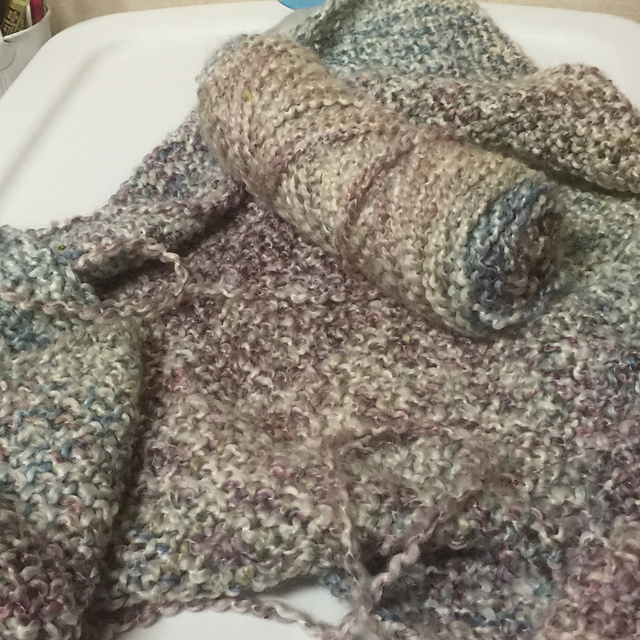
2)  Finished the shawl made of Lion Brand Homespun.  Still hate that yarn.  After spending a couple of hours looking at border designs in various books, I ended up crocheting a very simple border - think it was HDCs and chain stitches but it's been so long since I crocheted I don't remember my terminology.  I'm pretty happy with the final result, but I have no more Homespun and that makes me very happy.


3)  Finished weaving the purple and green triangle shawl and have 3/4 of the fringe twisted.  In the process I have remembered why I hate knotting fringe.  As much as I love just about everything to do with fiber, this is just so tedious!  The only redeeming feature is that I get to use a battery-powered gadget.  If I was twisting this any other way I might abandon it completely.

 There are several different fringe twisters available - mine is the Lacis power 4-ply.  It's very easy to use - you just clip up the ends of your yarn in up to four of the ends on the twister.  Pushing the power button one direction makes the ends spin individually.  Then pushing the button the other way makes the whole head of the twister spin the opposite direction, twisting your yarns into one fringe.


  Here's the fringe twister in action. 


Just to prove that I'm actually making progress with the fringe twisting:


In other fiber news, Alpaca Fest West was last weekend in Norco.  It was much smaller than the first time I went.  There were only a handful of vendors, but A Simpler Time, where I bought the Calypso Cloud Alpaca/Silk roving that I loved so much was there and I managed to do some damage to my budget.  Of course, I went having no intention of buying more fiber (hahahahahaha) but one does have to support the vendors at events, doesn't one?


 How could anyone resist this face?


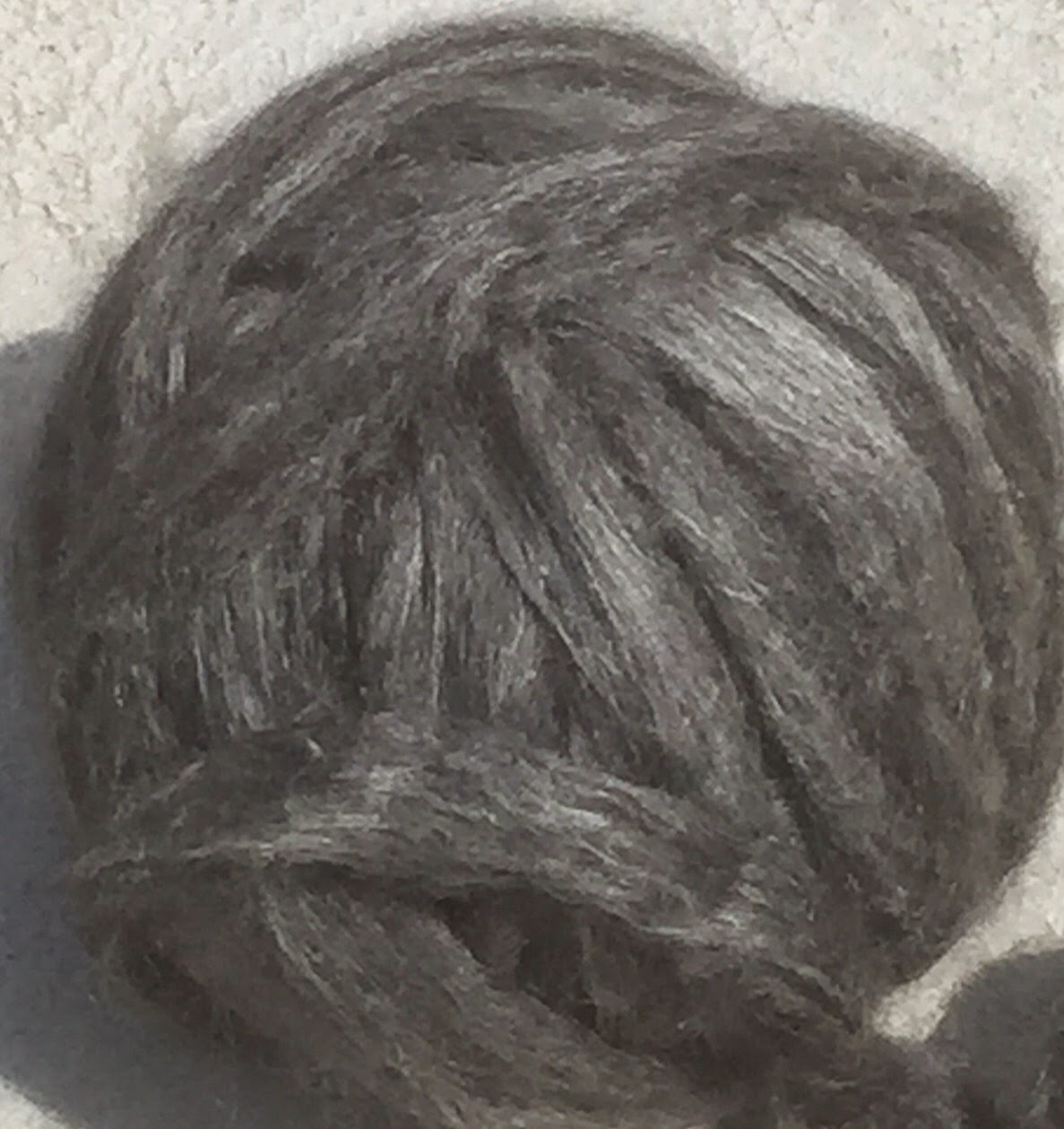
And the fiber I bought...  All alpaca or alpaca/silk except the center one, which is a Polwarth/Merino blend.  The colors on that one really do glow but are much richer than I was able to capture in a photo.




  And now to the sublime:
 
A few weeks ago, one of the members of my guild brought the most amazing rugs and bags woven from torn saris to a meeting.  They really captured my imagination and naturally I have been obsessing about weaving with sari silk ever since.

I'm blessed to have some amazing women in my life.  My friend Uwi is one of the most creative people I know.  I met her at class several years ago and I loved her on the spot for her fearlessness  joy in creating wonderful things.   And now we have become each other's enablers.

Uwi was equally if not more obsessed with the sari idea and we goaded each other into ordering a bale of used saris from India.  We ended up ordering 22 pounds of saris to share among four people. 


It took just two weeks for the box to arrive all the way from India.

Perfect timing, because we had class Wednesday night, so I loaded the box in my car and took it along.

I'm afraid I behaved like a 3-year old when we opened the box -- it was so exciting to see all the beautiful colors emerging.  I would love to have had something like this for dress-up when I was a kid, wouldn't you?


We had a great time dividing the saris into four piles - I think we managed to get a good variety of colors for each of us.  So I'm now the proud owner of 10 beautiful saris and loads of ideas.  Wish I could get a photo that shows the truly brilliant colors.


Yesterday I had a chance to examine them all...  Most of the fabric is in remarkably good condition.  There are some worn spots or tears that make them unusable as saris, but there is still a lot of good yardage so I may actually do more than just rag rugs.  I didn't find any stains and the saris seemed clean, but I gave each a cold bath with gentle soap. 

I was really surprised that the red fabrics bled very little, and even more surprised that all of the greens bled a lot.  See the amount of green in the water below?  This was the third rinse and this is a very bad photo.  Think "Emerald City" and you'll get a better idea of the amount of color coming out of these fabrics.


 I didn't notice any odor to the saris before washing, but one of them gave off a heavy mothball scent after it had been soaking for a few minutes.  So all of the newly washed saris will be spending the next few days getting some fresh air on my shaded back porch while I surf the web for more sari ideas.  And resist the temptation to order a few more bundles of silk.

In the meantime, here are some closer looks at my sari collection.  Please forgive the poor quality of the photos - they just don't show how gorgeous the colors actually are.


Saturday, March 14, 2015

The Great Personal Destash Challenge of 2015

There comes a time in (nearly) every crafter's life when they have to admit they have a problem. Mine time came about a week ago.

I've been wanting to use up some of my yarn stash and do some work with my rigid heddle loom but was short on inspiration.  So when someone mentioned Deborah Jarchow's class, Simply Stunning Scarves, on Craftsy, I signed up right away. I promised myself that I would  not buy any new yarns to do the class projects - surely I had enough already that I could easily find what was needed.

Wrong!  I had yarn stashed all over my studio, in closets, under tables - any place you could hide something, I had squirreled away a little (or a lot of) yarn.  I did find some lovely vintage handspun from Switzerland, and made the first scarf in the class (more on that at the end of this entry).  BTW - I highly recommend this class to rigid heddle beginners. 

When it came time to start the second scarf, I started the whole frustrating process of searching high and low again.  And quickly got fed up.  The result was that I collected my nine tubs (!) of yarn and all the bags and baskets hidden around the house and dumped them in the middle of my living room floor.


Here I have to confess three things:

1) this is after a major destash just last month.  I've already gone through my yarns and donated several cartons to my weaving class.  This is just the stuff I wasn't ready to part with.

2) this isn't all of it.  There are at least four or five different yarns I'm certain I still have hidden somewhere in the house - probably several skeins of each. 

3) this really isn't all of it.  I've deliberately excluded my sock yarn collection, my unspun fibers, and my handspun.  And the cones of yarn for machine knitting. Those are all problems for another time.

Phew, glad I got that off my chest.

So I thought I'd spend an hour or so sorting into neat little groups by texture.  I've already tried sorting by color and then by fiber content - neither method worked for me.  Six hours later, I had this:


In the process, I found half a dozen projects I've started in the last few years and lost track of.  They're now in buckets and baskets (about 9:00 in this photo) where they will remind me that they need attention. What you don't see here is the huge bag of yarn I culled out to donate to my weaving class.

Anyway, I put all the yarns tidily in their respective tubs, and was ready to get back to the business of weaving.  While sorting, I chose the yarn for my next scarf project, and actually got the loom warped.  Then decided I should probably find the yarn for the third scarf while I had all the tubs out.  And realized that I still had to go through every single tub to find what I wanted.

I bit the bullet, and have spent all of my spare time this past week updating my stash on Ravelry.  Every skein of yarn I own (with the exceptions confessed above) is now listed on my stash page with a photo.  This comprises 592.5 skeins of 221 different varieties or colorways of yarns weighing just over 105 pounds.  Egad!   This afternoon I finally finished and now have my tubs neatly put away on top of the bookshelves in my studio like so:


Each tub is labeled with the type or purpose of the yarn, and the date it was last sorted through.  Wonder if I'll be able to maintain this?


So here's the challenge part of this post.   I have promised myself that I will not buy any new yarn for the next six months.  Ok, so I originally promised myself no new yarn for a year, but who am I kidding?  I think I can make it for six months.  Or maybe three.  In the meantime, I will try to use up at least a quarter of the stash. That's 25 pounds of yarn in six months.  This could be either by finishing projects of my own, or sharing with one of my sisters, who has just begun her transformation to the darkside.  (She ordered her loomette last week  and I'm seeing a rigid heddle loom in her future,  mwa-ha-ha.)

To shame myself into completing some projects I started and set aside, here's what I've already committed to finishing:


A triangle shawl.  I finished the weaving part a couple of weeks ago but still need to finish the long edge and add the fringe.

The unused yarn for this project is not included in my stash.  Make that 106 pounds.


Another triangle shawl.  This is made with Lion Brand Homespun, which I will never, ever use again.  Any ends that aren't tied off unravel spontaneously.  Yuck.  I'll be looking for a crochet edging pattern to finish this one off.


A ribbed keyhole scarf using a pattern found on Ravelry. 


And a second scarf using the same pattern and chunky yarn.  How I came to start the same pattern twice, I have no clue.


The Bella Lana Reversible Cable Scarf, another pattern found on Ravelry.

 I’ve wanted to learn to knit cables for ages. I started and re-started this scarf half a dozen times before I put it on the shelf ‘temporarily.’ Unfortunately I think I gave away the other skein of yarn I had reserved for this scarf in my destash of February 2015. Guess I’ll be starting it again in a different yarn because I still do want to conquer cables.


The "Crammed and Spaced" scarf currently on my rigid heddle loom. 


And a few projects waiting in the wings:


Planning to use this fun eyelash yarn on my Spriggs adjustable rectangle loom.  I actually started it a couple of years ago but made a mistake right at the beginning that I discovered after  weaving about 15 rounds.  Couldn't figure out how to fix without frogging the whole thing.  Which I finally did last week.


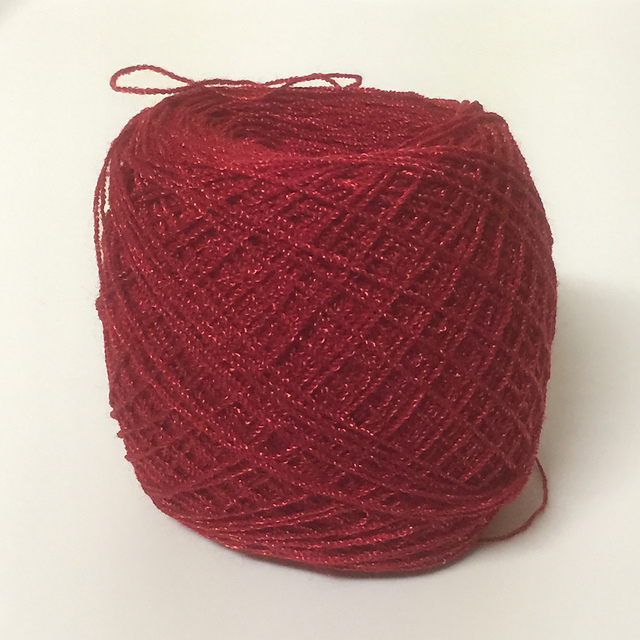
I was given this bag of gorgeous Chinese red yarn and discovered last week that a warp had already been cut from some of it. Looks to be about right for the length and width of a scarf, so I'll do this as a project in weaving class. Thinking about whether to just do a simple tabby or if it wants a twill tie-up.


I took a class in December 2013 on making Felfs - got as far as knitting my test swatch and dropped the ball. Will have to start over testing because I have no clue what happened to my first test and notes…

I think one skein should be enough to make one pair but I bought a second skein just to be safe.


And just to prove that I can actually finish something I start:

This is the open weave felted scarf from the Deborah Jarchow class I mentioned earlier.  I warped it on a Wednesday night and had it felted by Saturday night.  Note - the color looks different in each of the photos - this is due to my poor photography and not changes to the yarn.  The photo of the finished scarf is closest to the actual color of the yarn. 


This is the tag from the yarn I used.  It's part of the stash I was given when I bought my Gilmore loom from an estate.  Despite being handspun, it worked beautifully for both warp and weft and I didn't have a single break.


Project on the loom.  The purple strips are scrap-booking paper cut to 1" widths used for spacers.


The scarf after twisting and knotting the fringe, but before felting.


And (tada!) the scarf after felting. Since my washer is front-loading, it can't be used for felting.  I used a little countertop washer and checked the scarf every 2-3 minutes.  It took 21 minutes to reach this point.


Friday, February 6, 2015

Sock Blanks!


A few years ago at Convergence, I took a class from Nancy Roberts on "Machine Knitting to Dye For."  Nancy is a hand-knitter, but uses knitting machines to knit fabrics to be dyed and frogged, to make unique yarns that are then knitted by hand.

Being a gadget geek, and having 'fond' memories of a Japanese knitting machine that my mother tried unsuccessfully to use (the instructions were in Japanese) when I was a child, I couldn't pass up the chance to play with one under supervision.  And, of course, I came home with a machine. Since then, three (!) other flatbed knitting machines have joined my studio, gifted by a dear friend.  And my circular sock machine, Elias Cabot, has become a big, although neglected, part of my life.

I've talked about Elias and sock blanks before so I'm not going to bore you with a repeat of all that. Instead, I'll bore you with some photos.   I recently wrote an article for the CSKMS newsletter and didn't have the time or space to get these into the article.

SOAPBOX ALERT!  If you're interested in circular sock machines and are not already a member of CSKMS, please have a look at our website and check out our Ravelry group.  And if you're reading this in early 2015, consider joining so you can attend our upcoming conference.  We'll be making Socks in the Rockies July 29 - August 31 in Denver, Colorado.  More on that in a future blog post.


These are all swatches I made from sock yarn salvaged from a disastrous attempt to use my skein winder.  No actual socks were harmed in the making of these photos.

 A few words on dyeing techniques.  There are loads of different ways to 'cook' the color into yarn.  My favorite is the crockpot because I can walk away and leave it to its work for a few hours.   You can also steam in the microwave or in a pot on the stovetop but you have to watch them carefully.  BTW - any containers you use for dyeing (unless you're using edible dyes) should not be used for food afterward.

When you steam fabrics, you don't want them sitting in water.  I couldn't find a rack that fit inside my crockpot, so I poked holes in a pie tin.  I set it in the crockpot upside down and add as much water as I can without it rising above the bottom of the tin.  Then I stack my blanks rolled up in plastic wrap inside, put on the lid, turn the heat to 'high' and walk away.  In a few hours, my blanks are ready to be cooled, rinsed, and dried.


When you're working with actual sock blanks, you have to take into account the proportions of the sock blank to the final knitted sock.  Most of the finished swatches here are just flat pieces of fabric just 5" wide. The blanks varied from about six to 15 inches wide.  All of my blanks were knitted using a creamy white wool.  You can also use cotton or even (gasp) acrylic if you use the appropriate dyes and finishing technique for those fibers.  On either end of each blank I knitted a few rows of waste yarn (usually orange or green).  My knitted samplers usually have white waste yarn on both ends.

On this sample,  I just painted alternating stripes of orange, brown, and red on the diagonal. This is the blank immediately after painting.

Note that the orange on top and bottom is waste yarn and will not be part of the final swatch.


Here's the same blank after steaming in the crockpot.  You can see that the colors ran quite a bit, but the diagonal stripes are still pretty distinct.


And this is the result.

As much as I dislike hate orange, I love how it pops in the knitted sample.


This was an experiment to see if there was any difference in the amount of bleeding between a solid fabric and a fabric that had been 'laddered.'  I painted the same orange and green vertical stripes on the solid top and the laddered bottom.   Painting vertical stripes gives very short repeats of color.


The result:  I think I see a little less bleeding in the laddered swatch on the right - but that may just be coincidental pooling. 


In this swatch, I wanted to see what would happen if I used waste yarn (orange) between bands of sock yarn to mark stripe placement and control bleeding.


I did not take the time to make sure I had fully saturated each stripe with color.


The color irregularities you see here are not from bleeding, but from poor dye saturation.  Not my favorite sample...  Having the waste yarn between stripes did a good job preventing bleeding from one section to the next.


In this swatch, I was playing with the 'message' sock idea.  This is a fun idea to try with kids if they can be careful with dyes or if you have plenty of Reduran on hand.


This is the top portion that had the word 'happy.'  Although the turquoise mostly pooled on the left in this sample, it's coincidental, not intentional.


And this is the bottom portion with the polka dots. 


 I dyed this blank with a slightly olive green color - deliberately (this time) applying the dye unevenly.  I had hoped to get a heathery effect.   When it came out of the crockpot, it was just a yucky, mottled mess.  So I added the brown dots at random.

Evidence that sometimes mistakes can be corrected.


 This was just a little swatch where I was trying to play with color blocks.  It got pretty ugly.  I think that if I had left out the orange or the black, the final result wouldn't have been quite so jarring.


This is a full-sized sock blank I painted with a foam brush at my friend Loan's house when she had a fiber play day a couple of months ago.  I started out with just the purple and pink hearts, but it was pretty boring.  I added some slashes of turquoise then dipped the brush into each of the colors at random to blend them.  Also painted along the rolled selvedges of the blank to reduce the amount of white spots they would cause.

Below is the same yarn being turned into a sock by Elias Cabot (with a little assistance from me).   I got as far as the heel and lost my nerve.  But I WILL finish this sock someday soon.


1/15/2020:  Adding a few other examples from my article:


I used some of my favorite reds, blues, and purples in this, but it started out looking ugly and just kept getting worse.  But I was pretty happy with the way the yarn turned out and even happier with the knitted sample. By making the fabric blotchy all over, I avoided obvious striping and pooling.


This was a short, very wide blank.  I dyed the left half black, and painted alternating stripes of turquoise and yellow on the other half, letting them bleed  (the yellow stripe in the middle was waste yarn I was using to experiment with controlled bleeding). When knitted, the result was alternating stripes of black and color.


Below is an example of what you get if you divide your fabric in half diagonally and paint half blank, half another color.  Your edges will not be quite this crisp due to bleeding but you get the idea.